
Understanding Aerodynamics
Master the fundamental principles of flight with Jeremy&Kilo Aviation
The Four Forces of Flight
Every aircraft in flight is affected by four fundamental forces. Understanding how these forces interact is essential for safe and efficient flying. These forces are defined by the FAA as:
Forces in Climbs & Descents
Straight and Level Flight

In straight and level unaccelerated flight, all four forces are in equilibrium. Airspeed and altitude remain constant.
Key Concept
Weight always points directly toward the Earth's center, regardless of aircraft attitude. This is a critical concept for understanding climbs and descents.
Climbing Flight
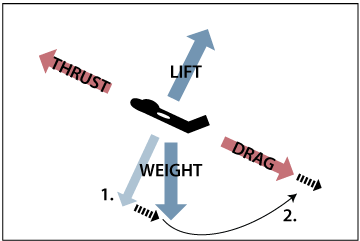
In a climb, the aircraft's longitudinal axis is inclined upward relative to the flight path.
What Happens in a Climb?
- Weight Vector Movement: As the aircraft pitches up, weight continues pointing straight down. Relative to the aircraft, weight appears to move backward.
- Increased Drag Effect: This rearward component of weight now acts in the same direction as drag, creating additional resistance to forward motion.
- Thrust Requirement: To maintain airspeed during a climb, thrust must be increased to overcome both drag AND the rearward component of weight.
Descending Flight
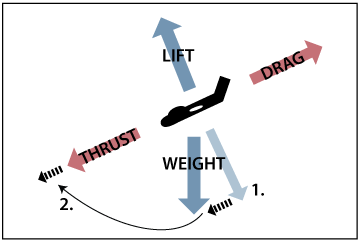
In a descent, the aircraft's longitudinal axis is inclined downward relative to the flight path.
What Happens in a Descent?
- Weight Vector Movement: As the aircraft pitches down, weight continues pointing straight down. Relative to the aircraft, weight appears to move forward.
- Added Thrust Effect: This forward component of weight now acts in the same direction as thrust, effectively adding to the propulsive force.
- Speed Control: To maintain constant airspeed during a descent, thrust must be reduced (or drag increased) to compensate for the forward component of weight.
Aerodynamics of Turning Flight
Understanding Lift Components in a Turn
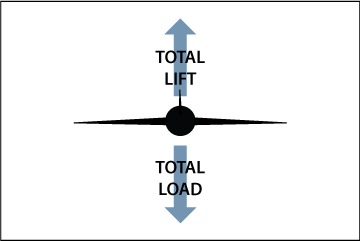
When an aircraft banks, total lift is divided into vertical and horizontal components.
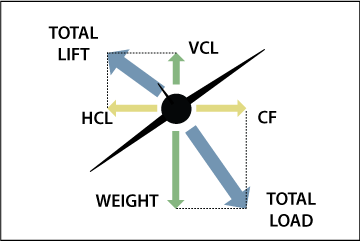
Without increasing lift in a turn, the aircraft will lose altitude.
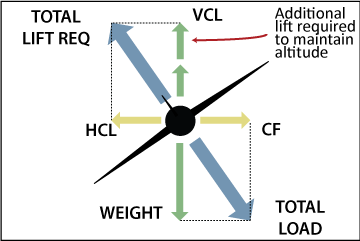
Increasing lift allows the aircraft to maintain altitude in the turn.
Lift Division in a Banked Turn
When you bank the aircraft, the total lift vector tilts with the aircraft. This lift is now divided into:
- Vertical Component of Lift (VCL): Opposes weight and maintains altitude
- Horizontal Component of Lift (HCL): Provides the centripetal force needed to turn the aircraft
Why Back Pressure is Required
Maintaining Altitude in a Turn
- Initial Bank: When you roll into a bank without adding back pressure, the total lift tilts but its magnitude stays the same.
- Reduced Vertical Lift: With the lift vector tilted, the vertical component is now less than the aircraft's weight.
- Altitude Loss: Since weight exceeds the vertical component of lift, the aircraft begins to descend.
- Adding Back Pressure: By increasing the angle of attack with elevator, you increase total lift. This increases the vertical component back to equal weight, maintaining altitude.
Coordinated vs. Uncoordinated Turns
Coordinated Turn
BALANCED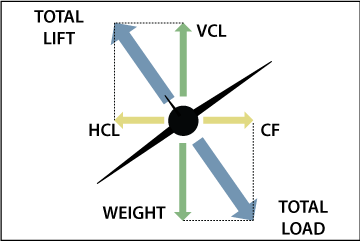
Characteristics:
- HCL = Centrifugal Force
- Ball centered in turn coordinator
- No side slip or skid
- Proper bank angle for rate of turn
✓ This is what we aim for in every turn
Slipping Turn
TOO MUCH BANK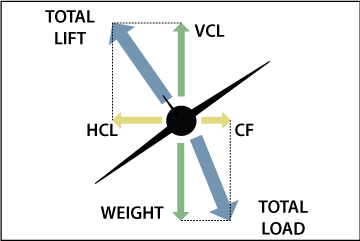
Characteristics:
- HCL > Centrifugal Force
- Rate of turn too slow for bank angle
- Aircraft yaws toward outside of turn
- Ball deflects to outside of turn
Correction:
- Decrease bank angle, OR
- Increase rate of turn (add rudder)
Skidding Turn
TOO MUCH RUDDER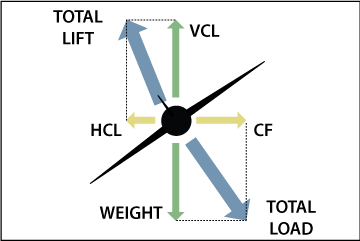
Characteristics:
- Centrifugal Force > HCL
- Rate of turn too fast for bank angle
- Aircraft yaws toward inside of turn
- Ball deflects to inside of turn
Correction:
- Reduce rudder input, OR
- Increase bank angle
Ready to Master Flight Training?
Learn these concepts and more with professional instruction at Jeremy&Kilo Aviation
Start Your Training Today