
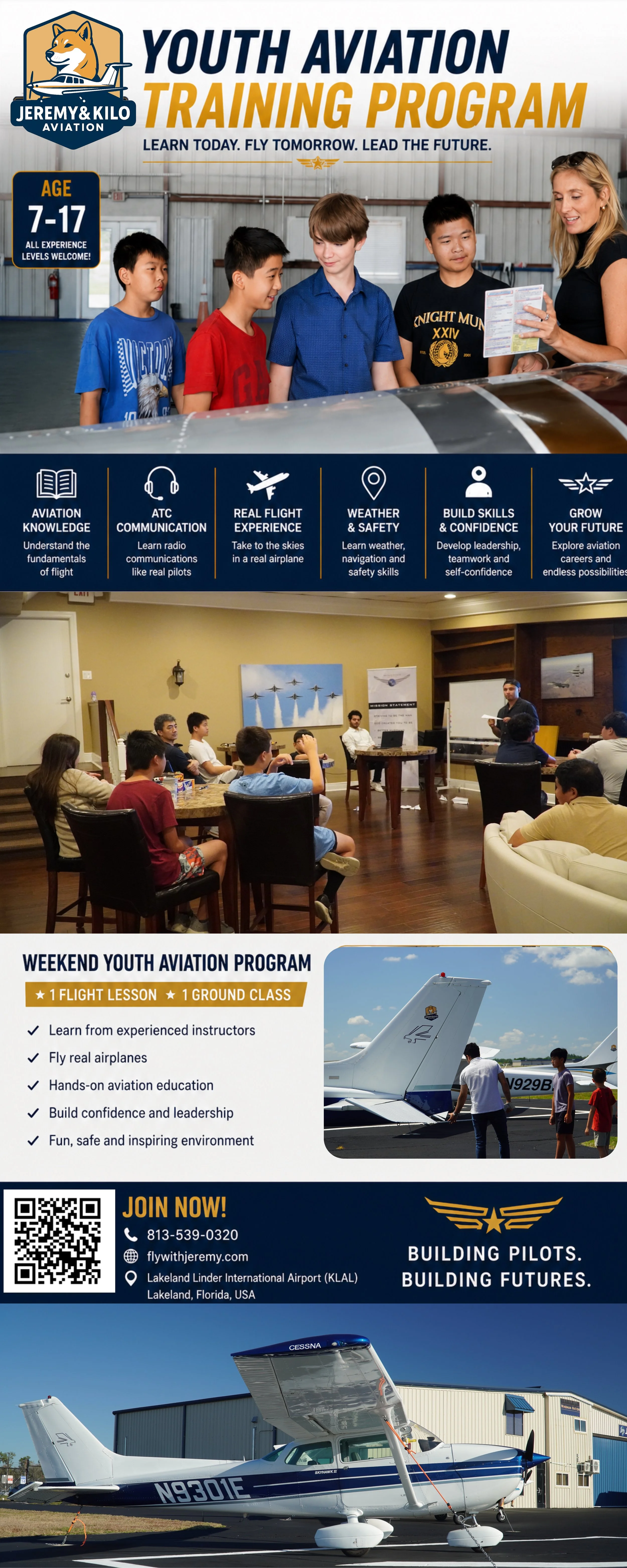
- 1.5+ hours of aviation ground training
- 45–60 minutes of 1-on-1 real flight training
- Fly with a Certified Flight Instructor (CFI)
- Aircraft systems, weather, safety & ATC communications
- Logbook entry included
flywithjeremy.com · Xavier Hangar (KLAL)
flywithjeremy.com · coffee & snacks provided
flywithjeremy.com · Coffe&Snack provided ;
01What is the Young Aviator Program?
A structured aviation training program for students ages 7–17 that combines aviation ground education with hands-on flight training in a real airplane — not a one-time discovery flight or sightseeing ride.
Students progressively learn aviation knowledge, aircraft operations, communication, safety, decision-making, and actual flying skills under the supervision of professional flight instructors.
02How much does the program cost?
Each weekend session is $299 and includes:
- At least 1.5 hours of group ground training
- Approximately 45–60 minutes of one-on-one flight training
- Real aircraft training with a Certified Flight Instructor (CFI)
- Training records/logbook entries when applicable
- Use of our aviation classroom, hangar, and training facilities
A structured multi-week training option is also available for families who want consistent participation.
03When are classes held?
Every Saturday, 10:00 AM – 1:00 PM
Jeremy & Kilo Aviation · 3240 Airfield Drive East, Lakeland, FL 33811 · Lakeland Linder International Airport (KLAL)
Flight schedules may extend beyond the group classroom period depending on student numbers, aircraft scheduling, weather, and airport operations.
04Does my child have to wait for a new class or semester to begin?
No — students can join at any time. Our curriculum covers different aviation subjects throughout the program, allowing new students to integrate into the class while continuing to build knowledge and flight experience week by week.
05What ages can participate?
The program is designed for students approximately 7–17 years old. Training is adjusted according to each student's age, maturity, experience, and ability — younger students focus on exposure, fundamentals, and confidence, while older students can progressively work toward more formal pilot-training objectives.
06Is this just a Discovery Flight?
No. A Discovery Flight is generally a one-time introduction to flying. Our program is progressive aviation education and flight training — students return regularly, learn new subjects, practice previous skills, and gradually build a stronger understanding of aviation and aircraft operation.
07What does my child learn during ground training?
Topics may include aviation fundamentals, principles of flight and aerodynamics, aircraft systems, airport operations, runways and taxiways, signs and markings, aviation weather, navigation and charts, flight planning, FAA regulations, safety and risk management, radio and ATC communication, CTAF operations, traffic patterns, collision avoidance, preflight inspection, aviation careers, and pilot decision-making.
We present professional aviation training concepts in an engaging, age-appropriate way for younger students.
08Will my child actually fly the airplane?
Yes. The flight portion is hands-on training in a real aircraft with a Certified Flight Instructor. Depending on age, experience, ability, weather, and safety, the instructor may allow the student to perform portions of the flight such as taxi procedures, straight-and-level flight, climbs and descents, turns, navigation, radio communication, traffic-pattern procedures, and eventually takeoff and landing training as they progress.
The CFI remains responsible for the safety of the flight and supervises the student throughout.
09Is the flight training one-on-one?
Yes. While ground training is generally a small group class, the flight-training portion is normally one student with one flight instructor, allowing the lesson to be adjusted to the student's experience and progress.
10Is the program safe?
Safety is our first priority. Flights are conducted with Certified Flight Instructors using training aircraft and established operating procedures. Before each flight, the instructor considers weather, aircraft condition, airport conditions, student readiness, flight objectives, and operational risks.
If conditions aren't appropriate for the planned flight, the lesson may be modified, delayed, rescheduled, or conducted as ground training.
11What happens if the weather is bad?
Aviation is weather-dependent, and learning when not to fly is part of becoming a safe pilot. If conditions are unsuitable, we may delay or reschedule the flight, modify the lesson, or conduct additional ground training. Safety always takes priority over completing a scheduled flight.
12Does completing the program give my child a pilot license?
No. The Young Aviator Program itself does not automatically award an FAA pilot certificate. A certificate can only be earned after the student satisfies all applicable FAA eligibility, aeronautical experience, knowledge, proficiency, and testing requirements.
For students serious about becoming pilots, the program provides a strong foundation and transition into formal flight training. Eligible instruction may also be logged when conducted in accordance with applicable FAA requirements.
13Can the flight hours count toward a future Private Pilot Certificate?
When flight instruction is provided and properly logged by an appropriately certificated flight instructor per FAA requirements, eligible training can count toward applicable aeronautical-experience requirements — a key difference between structured flight instruction and simply taking an airplane ride.
For students planning to pursue a certificate, our instructors can help structure and document training accordingly.
14How old does my child have to be to solo an airplane?
For an airplane Private Pilot pathway, a student can generally solo at age 16, provided all applicable FAA requirements and instructor endorsements have been satisfied. The instructor must determine the student has the required knowledge and proficiency to safely operate the aircraft alone.
15How old must someone be to earn a Private Pilot Certificate?
For an airplane Private Pilot Certificate, the minimum age is generally 17. This makes ages 15–16 an excellent time for a motivated student to begin structured training toward that milestone.
16My child is only 7, 8, 10, or 12 — is it too early?
Not necessarily. At younger ages the goal isn't to rush toward a pilot certificate — we focus on building aviation knowledge, developing confidence, introducing aircraft control, improving communication, encouraging responsibility, developing situational awareness, exploring STEM concepts, and creating long-term interest in aviation. Training becomes progressively more advanced as students mature.
17Does my child need previous aviation experience?
No previous experience is required. We welcome complete beginners as well as students who have already taken flight lessons or have significant aviation knowledge — instructors adjust training to the student's current level.
18Does my child need an FAA medical certificate?
A medical certificate is generally not required simply to begin dual flight instruction with an instructor. Additional FAA requirements apply before certain solo operations and certification pathways — we'll discuss these with you as your child's training progresses.
19Do parents need to stay during the class?
Parents are welcome to observe the ground-training portion and learn alongside their child. Flight participation and seating depend on the aircraft, weight and balance, instructor approval, operational considerations, and available seating.
20What should students wear and bring?
Wear: comfortable clothing appropriate for the weather and closed-toe shoes suitable for aircraft operations. Avoid loose items that could interfere with aircraft controls or become a distraction around airplanes.
Bring: a notebook, pen or pencil, water, sunglasses, weather-appropriate clothing, and any aviation materials previously provided by the instructor.
21What skills can my child gain besides learning to fly?
Aviation requires much more than manipulating aircraft controls. Our program helps develop confidence, leadership, communication, discipline, decision-making, situational awareness, and real-world STEM knowledge through math, physics, weather, navigation, and technology.
22Is aviation a realistic career path for my child?
Aviation offers many career paths beyond airline pilot, including corporate/private jet pilot, military aviation, flight instructor, air traffic controller, aircraft maintenance, aerospace engineering, airport operations, aviation management, unmanned aircraft systems, and emerging aviation technologies. Our goal is to expose students to the broader industry and help them discover what interests them most.
23What happens after the Young Aviator Program?
Students who develop a serious interest can transition into more individualized flight training, with a possible pathway of:
Young Aviator → Student Pilot → First Solo → Private Pilot → Instrument Rating → Commercial Pilot → Professional Aviation Career
There's no requirement to follow this path — some students participate simply because they love aviation and want an extraordinary educational experience.
24How quickly will my child learn to fly?
Every student progresses differently, depending on age and maturity, training frequency, preparation and study habits, individual learning ability, weather, aircraft availability, and consistency of training. We don't promise a particular milestone within a set number of lessons — our priority is safe, proficient, and confident development, not rushing students through training.
25What makes Jeremy & Kilo Aviation's program different?
Students receive real-world flight experience, structured aviation education, ATC and communication training, professional pilot-training concepts, experienced aviation mentors and instructors, career exploration, and confidence and leadership development.
We want students to walk away not only thinking "I flew an airplane," but "I understand aviation, I know what I'm capable of, and I can see a path toward my future."
flywithjeremy.com · Every Saturday · 10:00 AM – 1:00 PM